


Giant Floral Clock Pavilion with Sloped Living Dial for Civic Plazas and Parks
Giant Floral Clock Pavilion with Sloped Living Dial for Civic Plazas and Parks
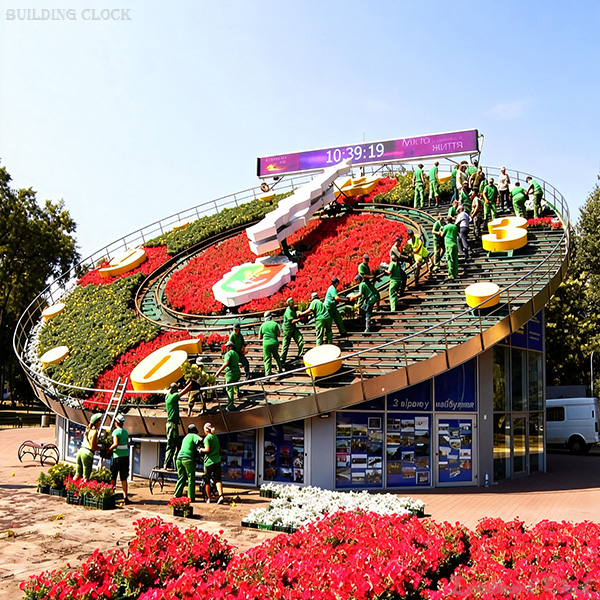
A floral clock can be a small garden feature, but at landmark scale it becomes a piece of public architecture: a living time display, a civic icon, and a programmable event backdrop. This project presents a mega floral clock designed as a tilted circular dial mounted above a dedicated pavilion. The result is not only visually dramatic from long distances and elevated viewpoints, but also operationally smart, because the structure under the dial supports visitor services, interpretation, and year round activation.
A landmark dial designed as architecture
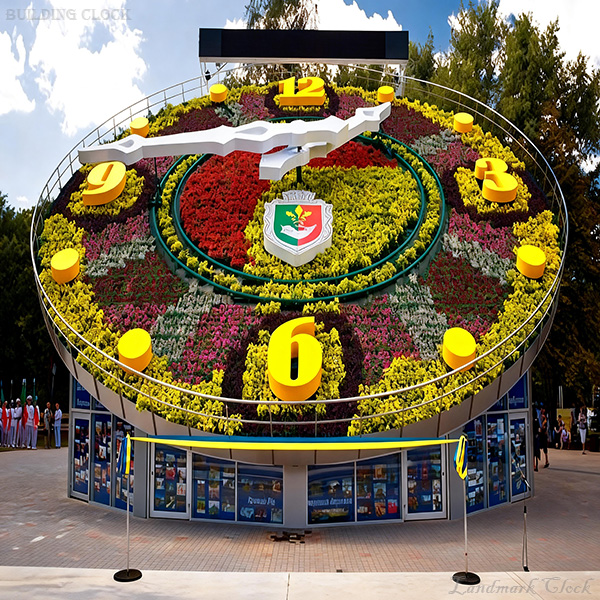
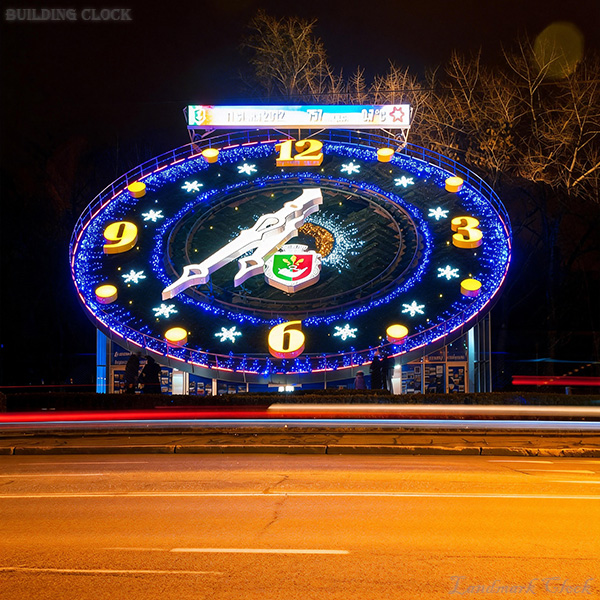
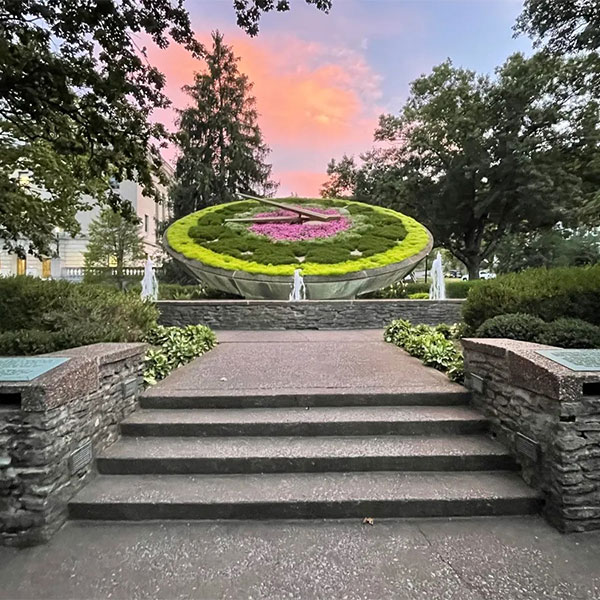
Unlike flat ground level floral clocks, this clock reads like a giant outdoor billboard for time. The dial is intentionally sloped to improve visibility from the main approach routes of a large public park and surrounding civic district. Bold three dimensional numerals and oversized sculptural hands create instant legibility for pedestrians, families, and tour groups, even when the planting palette changes seasonally. In this case, the dial diameter is reported as 22 meters, with an hour hand length of 8 meters and a minute hand length of 12.5 meters, placing it firmly in the mega scale category.
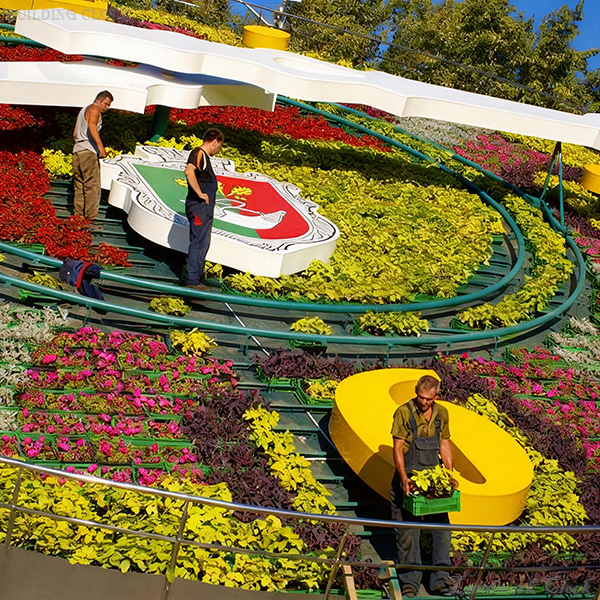
The planting design behaves like a living mosaic. Large color fields are arranged in concentric zones, creating strong contrast between outer bands, mid rings, and the central emblem area. This strategy helps the clock remain readable and photogenic in every season, and it supports maintenance planning because each ring can be replanted or refreshed as a controlled zone rather than disturbing the whole dial at once.
City identity and a dial that tells a story
At the center of the dial sits a prominent civic coat of arms, turning the clock into a recognizable symbol of municipal identity. For public clients, that emblem is more than decoration. It is a branding device that makes the clock a signature image for tourism campaigns, event posters, and media coverage. The crest also creates a natural anchor for interpretive storytelling: visitors intuitively understand that this is a city sponsored landmark rather than a generic garden ornament.
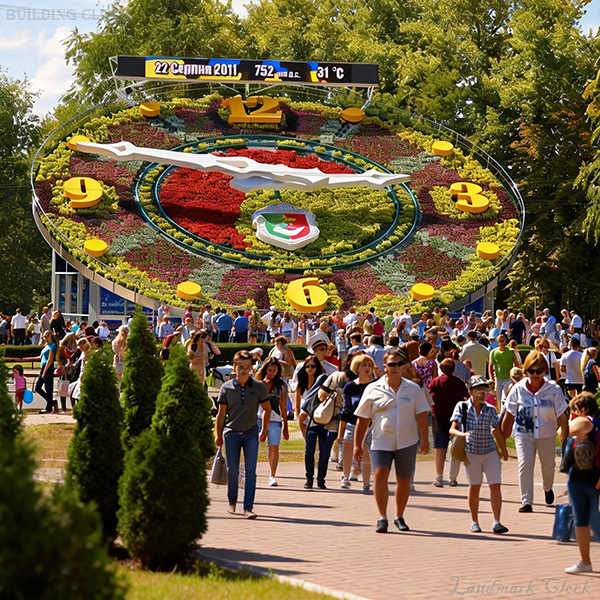
A large digital banner element above the dial further extends the storytelling potential. It can support public announcements, festival messaging, commemorations, and sponsor recognition in a controlled, high visibility format. When paired with seasonal planting themes, the landmark can be refreshed many times a year without changing the underlying structure, enabling continuous novelty while protecting capital investment.
The pavilion beneath the dial as a cultural facility
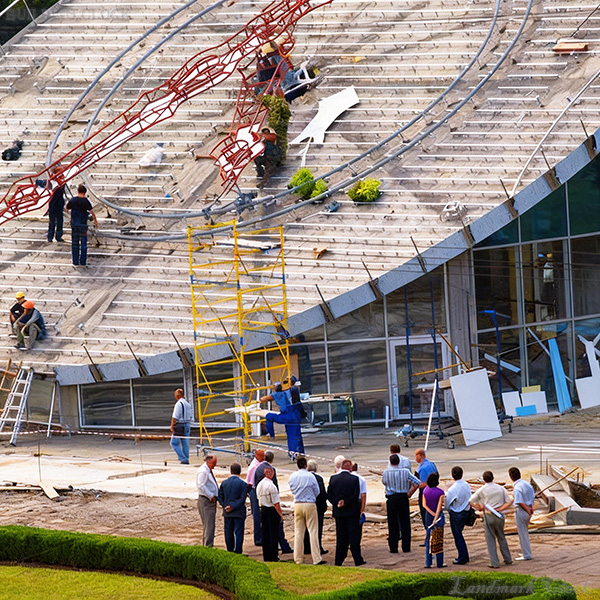
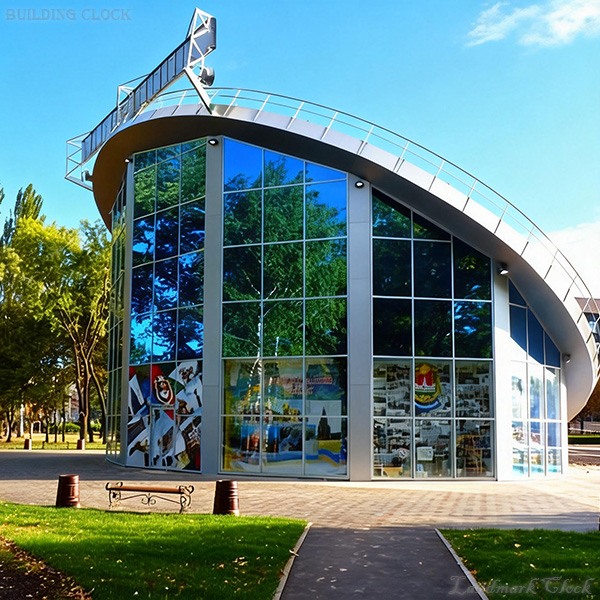
A key difference in this case is the functional building integrated under the floral dial. The space beneath the clock is reported to house a video gallery connected to a local history museum, allowing visitors to book tours and view films about the city. This transforms the floral clock from a photo spot into a hybrid destination that combines landscape architecture with indoor cultural programming.
From an owner and funder perspective, this matters because it extends dwell time and increases measurable public value. A floral landmark that also supports exhibitions, interactive media, and educational content can justify broader budget categories and unlock additional funding channels, including civic culture budgets, tourism development funds, heritage interpretation programs, and public private sponsorship packages.
Planning logic for owners, operators, and procurement teams
Public projects of this scale are rarely purchased as a single object. They are delivered as a coordinated package spanning structure, landscape, irrigation, power, controls, and visitor operations. A practical way to plan procurement is to treat the landmark as three linked scopes:
Civic architecture scope: pavilion structure, façade, internal fit out, life safety systems, accessibility, security, and exhibit infrastructure.
Clock engineering scope: heavy duty outdoor clock drive, hand sets, control cabinet, synchronization options, wind load design, and service access strategy.
Landscape and horticulture scope: dial bed build up, drainage, waterproofing at the dial, zonal irrigation, planting palette, soil media, maintenance pathways, and seasonal replacement plan.
This approach aligns with common public procurement routes such as Design Bid Build, Design Build, or EPC delivery, and it reduces risk because each contractor can be assigned clearly defined responsibilities with interface requirements and acceptance testing.
Visitor experience and crowd management
The surrounding hardscape and railings create clear boundaries between visitors and planting areas, protecting the dial edge while still allowing close range photography. The sloped dial creates a dramatic perspective and improves readability without requiring visitors to climb or approach hazardous areas. For parks and civic operators, this is essential: the landmark must be safe, durable, and predictable under heavy foot traffic, festivals, and peak season crowd loads.
Because the pavilion can accommodate interpretive exhibits, the site naturally supports guided visits, school programs, and heritage storytelling. That expands the stakeholder map beyond parks departments to include tourism boards, cultural bureaus, and municipal communications teams.
Lifecycle strategy and maintenance realism
Mega floral clocks succeed when design acknowledges that horticulture is a repeating operational cycle, not a one time installation. The planting should be specified around seasonal rotation windows, local climate realities, irrigation availability, and staffing. A ring based planting system allows targeted refreshes and helps control cost because high visibility zones can be replanted more frequently while background zones can rely on longer lasting species.
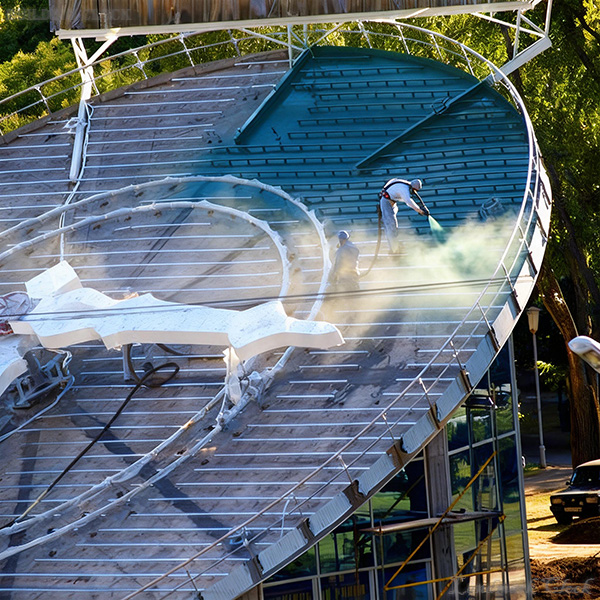
Mechanical reliability is equally important. Oversized hands require a high torque movement and robust mounting. Service access must be designed from day one, with lockable maintenance points, safe work procedures, and predictable calibration routines. This is particularly critical on sloped dial projects where gravity, water flow, and wind loads demand careful engineering coordination.
Why this model matters for future civic projects
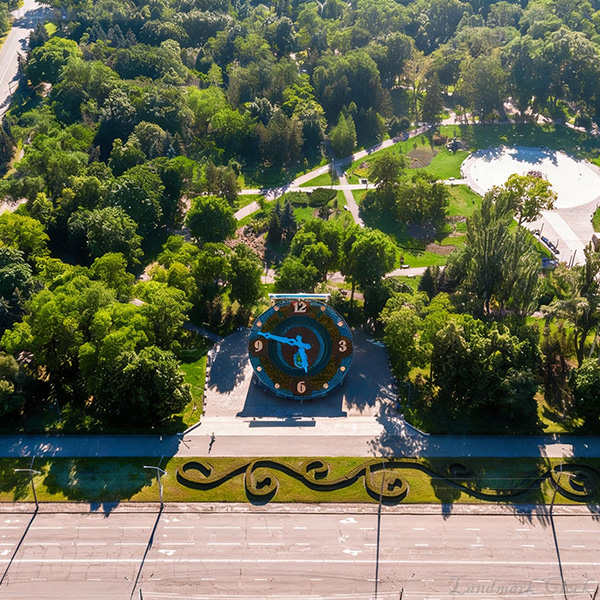
This case demonstrates an increasingly relevant direction in public realm investment: multi function landmarks that unify architecture, landscape, and interpretation. A mega floral clock pavilion can serve as a gateway marker, a wayfinding anchor, an educational museum node, and a year round photo magnet. In regions pursuing urban renewal, post industrial identity building, or new tourism corridors, a time landmark becomes a symbolic statement: the city is investing in public life, culture, and a renewed sense of place. The broader regional context is consistent with a major industrial city profile, reinforcing the value of visible civic place making.
Fixed Professional Content and Specification Table
Professional Notes Engineering and Landscape Integration
System Type: Mega outdoor floral clock with architectural pavilion and sloped living dial.
Typical Applications: Public parks, civic squares, cultural districts, waterfront promenades, tourism gateways, regeneration zones.
Design Principle: Permanent structural dial and pavilion infrastructure plus renewable seasonal planting display.
Readability: Oversized hands, bold markers, and high contrast planting zones designed for pedestrian and viewing distance legibility.
Architecture Integration: Dial mounted above a functional pavilion that can host exhibits, visitor services, ticketing, education, or media displays.
Civic Branding: Central emblem zone supports city crest, sponsor identity, anniversary themes, and ceremonial programming.
Operations Planning: Zonal maintenance strategy for dial rings, irrigation zones, and safe service access for mechanical systems.
Procurement Fit: Suitable for Design Bid Build, Design Build, EPC, or PPP style packages with clear interface specifications.
Public Safety: Crowd separation, anti climb detailing, tamper resistant access, wind load design, and safe maintenance procedures.
Specification Parameters Typical and Customizable
Item | Standard Configuration | Options and Notes |
Dial Diameter | Custom built | Mega range often 12 to 30 m depending on site and visibility goals |
Dial Orientation | Sloped dial on pavilion | Angle optimized for primary approach lines and viewing corridors |
Display Type | Oversized markers plus living planting mosaic | Arabic numerals, minimal markers, bespoke motifs, civic crest center |
Hands | High visibility hour and minute hands | Aluminum, stainless steel, FRP composite, heritage styled profiles |
Hand Size | Project driven | Mega projects can exceed 8 m hour and 12 m minute depending on dial |
Timekeeping Movement | Heavy duty high torque outdoor clock drive | Anti backlash design, industrial bearings, reinforced mounting |
Time Sync | Standard time setting | GPS, radio, or network synchronization optional |
Power Supply | AC mains | Solar hybrid possible with site verification and battery strategy |
Control Access | Lockable service access | Tamper resistant enclosure and maintenance friendly layout |
Structure and Mount | Engineered steel frame and central hub | Designed to local wind loads, snow loads, and corrosion category |
Dial Bed Construction | Waterproofing plus drainage and edge restraint | Enhanced drainage for irrigation control on sloped surfaces |
Irrigation | Zonal irrigation recommended | Smart controllers, moisture sensors, drought response programming |
Planting Strategy | Seasonal change planting zones | Water wise palette, festival themes, low allergen options |
Digital Display Option | None by default | LED banner for civic messaging, events, sponsor panels |
Lighting Option | None by default | Dial wash, hand highlight, event lighting integration |
Signage Option | Interpretive plaque optional | Donor panel, QR content, museum link signage |
Maintenance Plan | Seasonal planting plus routine service | Spare parts kit, annual calibration, on site training, SOP documents |
Pavilion Interior | Visitor gallery ready | Exhibit fit out, interactive media, ticketing, education room, storage |
Delivery Scope Typical
Clock movement, hands, hub, and mounting hardware
Dial geometry shop drawings including marker positions and hand clearances
Structural interface requirements and installation guidance
Dial bed system guidance including drainage, waterproofing, and irrigation zoning
Planting concept support for seasonal programs and ring based maintenance
Commissioning, calibration, and acceptance testing procedure
Optional spare parts package, training, and maintenance SOP documentation
Leave Your Message
Products categories
-
40-Foot Floral Clock Landmark for Public
-
Giant Floral Clock Pavilion with Sloped
-
Tropical Floral Clock Landmark for Publi
-
Giant Floral Clock for Civic Squares &am
-
Heritage Flower Clock Landmark for Urban
-
GPS-Synchronized Flower Clock Landmark f
-
Public Park Flower Clock with 2.5 m Seco
-
Flower Clock, Garden Floral clocks fc003
-
Flower Clock, Garden Floral clocks
-
Floral Clock, Garden Floral clocks